
Plan Your Dream Multi-Country Europe Adventure from Bangalore
Discover how to plan a multi-country Europe trip from Bangalore with smart route planning, realistic budgets, visa guidance, and travel tips from experienced tour operators.
Europe tour packages from Bangalore, multi-country Europe itinerary, Europe travel budget from India, best Europe routes from Bangalore
A couple from Sarjapur walked into our office last April with a Google Doc listing 14 European cities they wanted to cover in 12 days. Venice, Paris, Amsterdam, Prague, Vienna, Budapest, Rome, Barcelona — the whole continent squeezed into a fortnight. They’d watched every YouTube video, saved every Instagram reel, and were convinced it was doable. We had to tell them the truth: they’d spend more time at airports and train stations than actually experiencing Europe. That conversation changed their trip entirely — and made it infinitely better.
Planning a multi-country Europe trip from Bangalore isn’t just about picking pretty destinations. It’s about understanding geography, travel time, visa logistics, budgets that actually work, and routes that make sense when you’re flying halfway across the world. Most first-time Europe travelers make the same mistake — trying to see everything, and ending up exhausted.
Here’s what we’ve learned after planning dozens of Europe itineraries for Bangalore travelers: less is more, geography matters more than you think, and the right route can save you lakhs while giving you a better experience.
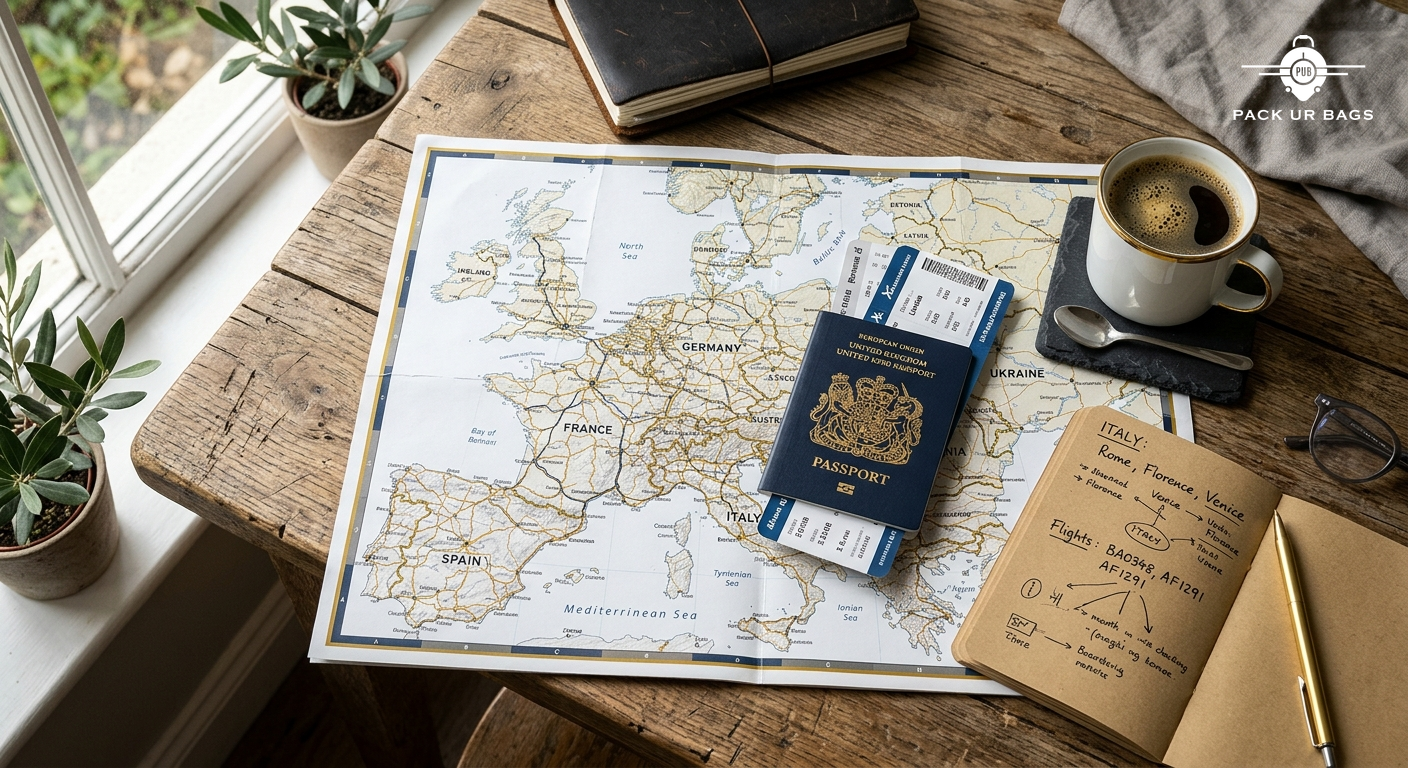
Why Multi-Country Europe Trips Are Perfect for Indian Travelers
Europe’s Schengen visa allows you to visit 27 countries on a single visa. That’s the big draw. Once you’ve spent the time and money getting that visa and flying to Europe, it makes sense to explore more than one country. But there’s a difference between smart multi-country planning and cramming your itinerary until it breaks.
Indian travelers — especially those flying from Bangalore — typically have 10 to 15 days of leave. That’s your realistic window. Factor in two days lost to long-haul flights, and you’re working with 8 to 13 usable days on the ground. Within that, you can comfortably cover three to four countries if you pick them intelligently.
The other advantage? Europe’s connectivity. High-speed trains, budget airlines, and well-maintained roads make it relatively easy to move between countries. A train from Paris to Amsterdam takes just over three hours. Flights between many European cities are cheaper than domestic flights within India. But only if you plan the route properly.
We’ve seen Bangalore travelers try to jump from Portugal to Poland in one itinerary. Technically possible, yes. Enjoyable? Not remotely. Every additional flight eats into your time, your budget, and your energy.
Step One: Pick Your Countries Based on Geography, Not Instagram
This is where most people go wrong. They pick destinations based on what’s trending, not what actually makes sense on a map. Let me be direct: if you’re planning a 10-day trip and your itinerary has you flying from Spain to Greece to Switzerland, you’ve designed a logistics nightmare.
Start with a region. Not the entire continent — a region. Western Europe: France, Belgium, Netherlands, Switzerland. Southern Europe: Italy, Greece, Croatia. Central Europe: Austria, Czech Republic, Hungary, Germany. Northern Europe: Scandinavia and the Baltics. Eastern Europe: Poland, Romania, Slovenia.
Once you pick a region, your route planning becomes infinitely easier. You’re working with neighbouring countries, short travel times, and natural progression. A Western Europe itinerary might flow Paris to Brussels to Amsterdam. A Central Europe trip might go Vienna to Prague to Budapest. These routes make geographic sense, which means less time moving and more time exploring.
Pack Ur Bags has built dozens of Europe tour packages from Bangalore, and the ones travelers remember fondly are always the ones where we prioritised depth over breadth. Three countries done well beats six countries done badly. Every single time.
One more thing: consider the season. Europe in summer is beautiful but crowded and expensive. Shoulder seasons — April to May and September to October — give you better weather than you’d expect, fewer tourists, and significantly lower costs. We’ve saved clients over ₹50,000 per person just by shifting their travel dates from July to early September.
The Best Multi-Country Europe Routes from Bangalore
You want a route that minimises backtracking, uses a mix of flights and trains, and lands you back at a major airport for your return flight to India. Here are the three routes we recommend most often, based on what actually works for Indian travelers.
The Classic Western Europe Loop
Start in Paris, end in Amsterdam or Brussels. This route covers France, Switzerland, and the Netherlands (or Belgium). You fly into Paris, spend three to four days exploring the city, then take a high-speed train to Interlaken or Lucerne in Switzerland. After two to three days in the Swiss Alps, you head north to Amsterdam. If you have extra time, add a day in Bruges or Brussels before flying back to Bangalore.
Why this works: It’s first-timer friendly, well-connected by trains, and covers three very different experiences — Parisian culture, Alpine landscapes, and Dutch canals. The entire route can be done without renting a car, which saves money and stress. Total ground time: 9 to 11 days.
Budget range for this route: ₹1.8 lakh to ₹3.2 lakh per person, depending on your accommodation choices, season, and how much you spend on experiences.
Central Europe: Vienna to Prague to Budapest
This is our favourite route for travelers who want history, architecture, and value. Start in Vienna, spend three days exploring palaces and coffee houses, then take a morning train to Prague (about four hours). After two to three days in Prague, continue to Budapest (another seven-hour train ride or a short flight). End with three days in Budapest before flying back.
Why this works: Central Europe is significantly cheaper than Western Europe, the cities are stunningly beautiful, train connections are excellent, and the food is fantastic. You’ll spend less and experience more. This route also tends to be less touristy than Paris or Rome, especially outside peak summer.
Budget range: ₹1.5 lakh to ₹2.5 lakh per person. That’s notably lower than Western Europe for a similar experience quality.
One thing we tell every client considering this route: book your trains in advance. Walk-up fares can be double or triple the advance-purchase price, especially on popular routes like Vienna to Prague.
Southern Europe: Rome to Florence to Venice
If Italy is your dream, this route keeps you within one country but gives you three completely different experiences. Start in Rome (three to four days), take a train to Florence (90 minutes), spend two days exploring Tuscany, then finish in Venice (two hours from Florence) for two to three days before flying out.
Why this works: It’s Italy in a nutshell — ancient history, Renaissance art, and romantic canals. Train connections are frequent and affordable. You can add side trips to Pisa, Siena, or the Amalfi Coast if you have extra days. And because you’re staying within Italy, you avoid the complexity of currency changes and cultural adaptation every few days.
Budget range: ₹1.7 lakh to ₹3 lakh per person, depending heavily on your Venice accommodation choice and how much you eat out.
At Pack Ur Bags, we’ve noticed that couples and honeymooners lean toward this route, while families and groups prefer the Western Europe loop for its variety.
Breaking Down the Budget: What a Multi-Country Europe Trip Actually Costs from Bangalore
Let’s talk real numbers. Not best-case, not budget-backpacker-hostel numbers — realistic costs for a comfortable trip that doesn’t involve sleeping in airport lounges or eating bread for every meal.
A 10-day, three-country Europe trip from Bangalore typically costs between ₹1.8 lakh and ₹3.5 lakh per person. That range exists because your choices matter — a lot. Here’s where the money actually goes.
Flights: Bangalore to Europe return flights range from ₹45,000 to ₹85,000 depending on season, airline, and how far in advance you book. Gulf carriers (Emirates, Qatar, Etihad) are usually the sweet spot for price and comfort. Book at least 90 days in advance for better rates. We’ve seen clients save ₹25,000 per ticket just by booking in February for a September trip instead of waiting until June.
Accommodation: Budget ₹3,500 to ₹8,000 per night for a clean, centrally-located three-star hotel or Airbnb. Hostels can drop this to ₹1,500 to ₹2,500, but most Indian families aren’t comfortable with shared bathrooms. For 10 nights across three cities, expect ₹40,000 to ₹80,000 per couple. Paris and Switzerland sit at the higher end; Central and Southern Europe skew lower.
Intercity transport: Trains between major European cities cost ₹2,000 to ₹6,000 per person per journey if booked in advance. Budget flights (Ryanair, EasyJet, Wizz Air) can be cheaper — sometimes as low as ₹1,500 — but factor in baggage fees and airport transfers. For three intercity moves, budget ₹10,000 to ₹20,000 per person.
Food: If you eat one meal out and cook or grab simple lunches, expect ₹1,500 to ₹2,500 per person per day. That’s ₹15,000 to ₹25,000 for 10 days. Western Europe costs more; you’ll find great meals in Budapest or Prague for half of what you’d pay in Zurich.
Sightseeing and experiences: Museum passes, guided tours, Alpine excursions — budget ₹15,000 to ₹40,000 per person depending on what you want to do. A Seine river cruise in Paris costs around ₹1,200. A day trip to the Jungfraujoch in Switzerland can run ₹12,000. Pick your splurges.
Visa fees: Schengen visa costs around ₹7,500 per person including VFS service charges. Travel insurance (mandatory for Schengen) adds another ₹1,500 to ₹3,000 per person depending on coverage.
Local transport: Metro and tram passes in European cities cost ₹300 to ₹800 per day. For 10 days across multiple cities, budget ₹5,000 to ₹8,000 per person.
Add it all up and you’re looking at roughly ₹1.8 lakh to ₹3.2 lakh per person for a solid mid-range trip. Go budget and disciplined, and you can bring it down to ₹1.4 lakh. Want luxury hotels, Michelin dining, and first-class trains? You’re easily crossing ₹4.5 lakh per person.
One common mistake: underestimating how much you’ll spend once you’re there. Europe is expensive, and even small daily costs add up fast. At Pack Ur Bags, we build a realistic day-by-day expense sheet for every client so there are no surprises mid-trip.
Visa Process and Documents You’ll Need
You can’t visit Europe without a Schengen visa, and the process isn’t difficult — just documentation-heavy and time-consuming. Start at least 60 days before your planned departure. You can apply as early as six months out, but most people apply around 45 to 60 days prior.
Here’s what you need: a passport valid for at least six months beyond your return date, with at least two blank pages. A completed Schengen visa application form. Two recent passport-sized photos. Confirmed return flight bookings (you don’t need to pay in full; a hold or reservation works). Proof of accommodation for every night you’ll be in Europe — hotel bookings or Airbnb confirmations. Travel insurance covering at least €30,000 in medical expenses, valid across all Schengen countries.
You’ll also need financial proof: three to six months of bank statements showing stable income or savings, income tax returns, and a cover letter explaining your travel itinerary and intent to return to India. If you’re employed, include a leave approval letter from your employer. If you’re self-employed, business registration documents help.
The tricky part: which country’s consulate to apply through. The rule is simple — apply through the country where you’ll spend the most nights. If you’re spending four nights in France, three in Switzerland, and three in the Netherlands, apply for a French Schengen visa. If two countries tie for the longest stay, apply through whichever one you’ll enter first.
Visa fees are around ₹7,500 per adult (including VFS service charges), and processing takes 10 to 15 working days on average. We’ve seen approvals in seven days and delays stretching to 25 days, so don’t cut it close.
One thing we’ve learned from processing visas for our clients at Pack Ur Bags: the cover letter and itinerary matter more than people think. A vague, copy-pasted letter raises red flags. A clear, specific day-by-day itinerary with logical routing and confirmed bookings dramatically improves approval odds. We’ve had exactly two visa rejections in the last three years, and both were cases where clients applied on their own without a solid itinerary.
Best Time to Book Flights and Get the Best Deals
Timing isn’t everything, but it’s close. Flight prices from Bangalore to Europe swing wildly depending on season, day of the week, and how far in advance you book.
The sweet spot for international flight bookings is 75 to 120 days before departure. Too early and prices haven’t dropped yet. Too late and you’re paying peak rates. We track this constantly for our Europe tour packages from Bangalore, and the pattern holds consistently.
Seasonality matters even more. July and August are peak summer travel months — flights are expensive, hotels are packed, and popular attractions have hour-long queues. December is holiday season, especially around Christmas and New Year — prices spike again. If you have flexibility, travel in April, May, early June, September, or October. You’ll save ₹20,000 to ₹40,000 per person on flights alone, get better hotel rates, and enjoy pleasant weather with far fewer crowds.
Airlines to consider: Emirates, Qatar Airways, Etihad, Turkish Airlines, and Lufthansa all fly from Bangalore to major European cities with one stop. Gulf carriers usually offer the best balance of price, schedule, and comfort. Avoid booking through third-party aggregators if you can — go direct with the airline or through a trusted travel agent who can hold seats and adjust bookings without penalty nightmares.
One trick that works surprisingly often: flexible date searches. If your travel dates can shift by even two or three days, you might find flights ₹15,000 cheaper. Flying out on a Tuesday or Wednesday instead of Friday can make a noticeable difference.
And here’s something most people miss: your return city doesn’t have to be your arrival city. Open-jaw tickets — flying into Paris and out of Rome, for example — often cost the same or even less than return tickets to the same city, and they save you the time and money of backtracking. We use this routing on nearly half the Europe itineraries we build at Pack Ur Bags.
How to Move Between Countries: Trains, Flights and Rental Cars
Once you’re in Europe, how you move between countries shapes your entire experience. Each option has trade-offs.
Trains are our default recommendation for most routes. They’re comfortable, punctual, connect city centres directly (no airport transfers), and let you see the countryside. High-speed trains like the Thalys (Paris to Amsterdam), TGV (France), and ÖBB Railjet (Central Europe) are fast and efficient. Book in advance through the official national rail sites or Omio, and you’ll get significantly cheaper fares than walk-up tickets. A Paris to Amsterdam ticket booked a month ahead might cost ₹3,500; the same ticket bought at the station can run ₹8,000.
One caution: Eurail passes sound great in theory but rarely save money unless you’re taking a train every single day. Run the math on individual tickets first. We’ve found that point-to-point tickets almost always come out cheaper for itineraries covering three to four countries over 10 days.
Budget flights work well for longer distances — say, Rome to Barcelona or Vienna to Lisbon. Ryanair, EasyJet, and Wizz Air offer flights for as low as ₹1,500 to ₹4,000, but watch the fine print. Baggage fees, seat selection charges, and distant secondary airports can erase the savings. A “cheap” flight to Paris Beauvais can cost you an extra ₹1,200 and 90 minutes each way just to reach central Paris. Factor in total cost and total time before booking.
Rental cars make sense if you’re exploring rural areas — Tuscany, the Swiss Alps, the French countryside. They don’t make sense for city-hopping. Parking in European cities is expensive and stressful, and public transport is almost always faster. If you do rent, book through a reputable international company, ensure you have international driving permit, and get full insurance. Driving laws and toll systems vary widely by country.
At Pack Ur Bags, we usually design itineraries around trains for the main intercity moves, with occasional budget flights for longer jumps and rental cars only when the itinerary includes countryside exploration that public transport can’t cover.
Packing Tips for Multi-Country Europe Travel
Pack less than you think you need. That’s the rule. You’re moving cities every two to three days, and dragging a massive suitcase up narrow hostel stairs or onto crowded trains is miserable.
One checked bag and one carry-on per person is the ideal. Go for a 60-litre suitcase or a large backpack, not the massive 80-litre hard-shells. You’ll be walking more than you expect, and lighter bags make everything easier. European hotel rooms and Airbnbs are smaller than Indian hotel rooms — there’s often barely space to open a large suitcase.
Clothing: Europe’s weather varies widely even within a single trip. If you’re visiting in spring or autumn, layer. A light waterproof jacket, a warm fleece, and versatile clothes you can mix and match work better than bulk. Jeans, neutral trousers, a couple of shirts, one slightly dressier outfit for nicer dinners. Comfortable walking shoes are non-negotiable — you’ll easily walk 10 to 15 kilometres a day in most European cities.
Don’t pack hair dryers, towels, or bulky toiletries. Hotels provide basics, and you can buy anything you forget at a local pharmacy for a few euros. Do pack a universal adapter (Type C plug for most of Europe), a small power bank, and any prescription medications with a copy of the prescription.
One thing we tell every client: pack a small day bag or backpack for sightseeing. You’ll carry water, snacks, a jacket, your phone, and a guidebook or map. A 15 to 20-litre daypack is perfect and doubles as your carry-on for flights.
And a practical tip from experience: keep one full change of clothes in your carry-on. Airlines do lose luggage, and arriving in Paris with nothing but the clothes you flew in isn’t fun.
Common Mistakes to Avoid When Planning a Multi-Country Europe Itinerary
We’ve seen the same mistakes repeated dozens of times. Here’s what not to do.
Trying to see too much. It’s the classic first-timer error. Europe will still be there next time. Three countries in 10 days is comfortable. Five countries in 10 days is rushed. Seven is punishing. Every time you change cities, you lose half a day to packing, checking out, traveling, checking in, and orienting yourself. Plan for fewer destinations and actually enjoy them.
Ignoring travel time. A quick look at a map makes Prague and Paris look close. The train takes over 10 hours. What looks like a short hop often isn’t. Budget at least half a day for every city-to-city move, and don’t plan anything important on travel days.
Booking non-refundable everything. Plans change. Flights get delayed. You might love a city and want to stay an extra day. Booking the absolute cheapest non-refundable options locks you in and removes all flexibility. Spend a little more for flexibility where it matters — especially on accommodation and trains.
Underestimating costs. Europe is expensive, full stop. A coffee costs ₹300 to ₹400. A simple lunch is ₹800 to ₹1,200. Entry to major museums and attractions runs ₹1,200 to ₹2,500. Budget generously, because running out of money halfway through your trip is a special kind of stressful.
Skipping travel insurance. It’s not optional — it’s literally required for a Schengen visa. But beyond the bureaucracy, it’s also sensible. Medical emergencies in Europe are horrifically expensive without insurance. A single hospital visit can cost thousands of euros. Spend ₹2,000 on good coverage and forget about it.
Not researching local holidays and closures. Many European museums and attractions close on Mondays. Some cities essentially shut down on Sundays. Major holidays like Easter can disrupt transport and open hours. A quick check before you finalise daily plans saves disappointment.
We’ve had clients show up in Paris on a Monday, excited to visit the Louvre, only to find it closed. A five-minute Google search would’ve avoided that. Little things like this add up.
Frequently Asked Questions
How much does a multi-country Europe trip cost from Bangalore for two people?
A comfortable 10 to 12-day multi-country Europe trip from Bangalore typically costs ₹3.6 lakh to ₹6.5 lakh for two people, covering flights, accommodation, intercity travel, food, sightseeing, and visa fees. Budget travelers can bring it down to ₹2.8 lakh by choosing hostels, cooking some meals, and traveling in shoulder season, while luxury trips can easily exceed ₹9 lakh with premium hotels and experiences.
Which is the best multi-country route for first-time Europe travelers from India?
The Paris-Switzerland-Amsterdam route is ideal for first-timers — it covers three distinct experiences, trains are frequent and easy to navigate, and the cities are well set up for tourists. Alternatively, the Vienna-Prague-Budapest Central Europe loop offers excellent value, beautiful architecture, and fewer crowds, making it perfect for travelers seeking culture without the Western Europe price tag.
Do I need separate visas for each country in Europe?
Not if you’re visiting Schengen Area countries. A single Schengen visa allows you to travel across 27 European countries including France, Italy, Spain, Germany, Netherlands, Switzerland, Austria, and more. Apply through the consulate of the country where you’ll spend the most nights, and ensure your itinerary clearly shows your planned route and accommodation for every night.
Is it cheaper to fly or take trains between European countries?
It depends on the distance and how far in advance you book. Trains are usually better for short to medium distances (Paris to Brussels, Vienna to Prague) — they’re faster city-centre to city-centre, more comfortable, and competitively priced when booked early. Budget airlines can be cheaper for longer distances (Rome to Barcelona), but factor in baggage fees, airport transfers, and time lost to airport security when comparing total cost and convenience.
Ready to Plan Your Europe Adventure? Let’s Make It Real
Planning a multi-country Europe trip from Bangalore isn’t about ticking every famous landmark off a list. It’s about designing a route that makes sense, budgeting realistically, moving efficiently, and giving yourself enough time to actually experience the places you visit.
We’ve planned Europe itineraries for Bangalore travelers with every budget and travel style — honeymooners wanting romantic escapes, families with kids, groups of friends, solo travelers, first-timers and seasoned explorers. What works is always the same: fewer destinations done well, smart routing, and realistic daily plans that don’t leave you exhausted.
If you’re sitting there with a rough idea of dates, a general sense of budget, and a head full of questions about visas, flights, and whether Venice is worth the hype (it is, despite the crowds), that’s exactly where Pack Ur Bags comes in. We don’t sell generic packages. We build custom Europe itineraries based on what you actually want to see, how you like to travel, and what your budget honestly allows.
Call us at +91-9150017657 or visit our office in Sarjapur, Bangalore. Let’s talk about your Europe trip — the real one, not the impossible Instagram version — and plan something you’ll actually remember for the right reasons.