
You’ve got limited leave days. Two destinations you’re dying to visit. And zero clarity on how long you actually need at each.
It’s not about what you can afford. It’s about what the destination needs to show its best side — and what you need to actually feel like you’ve travelled, not just ticked a box.
At Pack Ur Bags, we’ve seen this play out hundreds of times with travellers from Bangalore. Someone books three days in Ladakh because it’s “just a quick trip.” They land tired, spend a day adjusting to the altitude, rush through Pangong, and fly back exhausted. Then there’s the couple who booked ten days in Goa and ran out of things to do by day six.
The destination tells you how long it needs. Your job is to listen before you book the flights.
Here’s how to actually match your trip duration to where you’re going — without wasting days or cutting things short.
Start with What the Destination Needs, Not What You Have
Most people work backwards. They check their leave balance, pick a number, and try to fit a destination into it. That’s why half of all trips either feel rushed or drag.
Flip it. Ask what the place actually requires to feel complete.
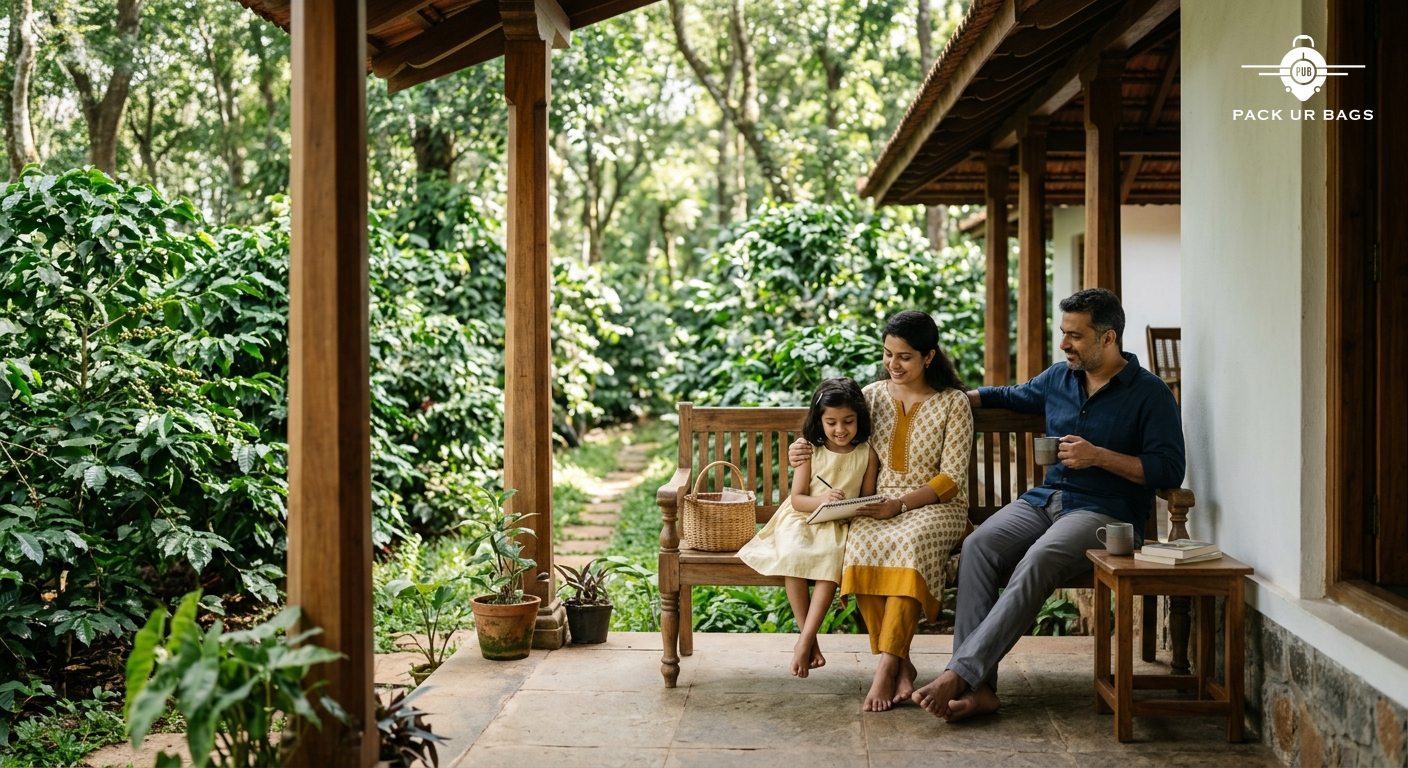
A weekend in Coorg works because you can cover the coffee estates, a waterfall, and a night at a quiet homestay without feeling like you missed the point. A weekend in Rajasthan doesn’t — because you’ll spend half your time in transit between Jaipur, Udaipur, and Jodhpur, and the other half wishing you had more margin.
We’ve had clients try to squeeze Kerala’s backwaters, hill stations, and beaches into four days. It’s technically possible. It’s also miserable. You’re packing, unpacking, driving, checking in, checking out — never settling into the rhythm of the place.
Here’s the baseline we use when planning itineraries:
Weekend trips (2–3 days) work for destinations within 3–4 hours of Bangalore — Coorg, Chikmagalur, Kabini, Wayanad, Pondicherry. You leave Friday night, spend Saturday and Sunday exploring, return Monday morning. Minimal travel fatigue. Maximum immersion in one micro-region.
Short breaks (4–6 days) suit single-state or single-region destinations that need a bit more unpacking — Goa, Kerala (one zone only), Himachal (Manali or Dharamshala, not both), Ladakh if you’re flying in and sticking to Leh-Pangong. You’ve got time to settle, explore without sprinting, and still return recharged.
Long holidays (7–10 days) are for multi-city itineraries or destinations with serious geographic spread — Rajasthan’s golden triangle, Northeast India, Kashmir from Srinagar to Gulmarg to Pahalgam, or international trips like Thailand or Bali where you’re combining beaches, culture, and adventure.
Extended trips (10+ days) fit Europe, Vietnam, or any destination where the experience improves the longer you stay — because you stop behaving like a tourist and start noticing things.
The mistake isn’t picking the wrong number. It’s ignoring the destination’s natural rhythm and trying to bend it to your calendar.
Factor in Real Travel Time, Not Just Flight Duration
Everyone checks flight time. Almost no one accounts for the hours before and after.
A flight to Goa is 90 minutes. But you’re at the airport two hours early. You land, wait for bags, pick up the rental car or wait for the cab. Drive 45 minutes to your hotel. Check in. Unpack. By the time you’re actually in Goa and ready to do something, it’s late afternoon.
That’s half a day gone. On the return, same thing in reverse.
For a weekend trip, that means you’ve really got one full day in the middle. If the destination needs more than that to make sense, it’s the wrong duration.
We’ve had clients book two-night trips to Andaman. They lose day one to travel. Lose day three to the return flight. Spend day two on a single island tour, exhausted. They saw Port Blair. They didn’t see Andaman.
Here’s the filter: if total travel time (door to destination and back) eats more than 30 percent of your trip, you’re planning it wrong. Either add days or pick somewhere closer.
For weekend trips from Bangalore, stick to destinations within a 300–400 km radius. Coorg, Mysore, Ooty, Kabini, Pondicherry, Hampi, Gokarna. You can drive or take a short flight, land fresh, and still have most of day one to explore.
For short breaks, you can stretch to Goa, Kerala, or a quick flight to Rajasthan or Himachal — but only if you’re staying in one zone. Udaipur for four days works. Udaipur-Jaipur-Jodhpur doesn’t.
For long holidays, international destinations start making sense. An eight-hour red-eye to Thailand or Dubai lets you sleep on the plane and land ready. You’ve still got six or seven full days to move through the itinerary without the trip feeling like a logistical relay race.
The real test: if you spend more time getting there than being there, pick a different destination or add more days.
Match the Itinerary Density to Your Energy Level
Some destinations are dense. Every day is packed — temples, markets, treks, transfers, early starts. Others are slow by design. You wake up, have breakfast by the water, read a book, take a walk, maybe visit one thing.
Both are valid. But they need different durations.
A weekend in Hampi works if you’re comfortable with intensity. Two full days of ruins, boulders, sunrise climbs, cycling between sites. You’ll return tired but satisfied. A weekend at a quiet resort in Kabini works because the whole point is to do less — a safari, some river time, and a lot of sitting still.
The problem is when people book a slow destination for ten days or a dense one for three.
We had a couple book a week in the Maldives. By day four, they were bored. There’s only so much ocean gazing you can do before you start wondering why you didn’t just go to Goa for half the cost. The Maldives is stunning — but it’s a four- or five-day destination unless you’re the kind of person who can genuinely unplug for longer.
On the flip side, clients who try to do Kashmir — Srinagar, Gulmarg, Pahalgam, Sonamarg — in five days come back drained. Every day is a new location, a new hotel, a new set of logistics. It works for seven or eight days when you can add buffer time and slow mornings.
Here’s how to self-assess:
If you want action, culture, variety, and full days — pick a longer trip and a destination that rewards movement. Rajasthan, Vietnam, Northeast India, Thailand.
If you want rest, repetition, and a chance to stop thinking — pick a shorter trip and a slower destination. A beach resort in Goa, a coffee estate stay in Coorg, a houseboat in Kerala’s backwaters.
And if you genuinely don’t know what you need, default to the middle. Six days. One region. A mix of scheduled experiences and open mornings. That’s the sweet spot for most people who haven’t travelled in a while.
Check Seasonal Restrictions and Permit Timelines
Some destinations aren’t just about preference. They’re about permissions, weather windows, and bureaucratic lead time.
Ladakh is a perfect example. You need a minimum of five to six days to avoid altitude sickness ruining half your trip. You also need an Inner Line Permit for Pangong Tso and Nubra Valley — which means advance paperwork. Rush it into a weekend, and you’ll either skip the best parts or spend the whole time feeling sick.
Andaman is another one. Ferry schedules between islands are fixed. Havelock to Neil Island runs only on certain days. If your itinerary doesn’t align with the schedule, you lose a full day waiting. That turns a four-day trip into a three-day trip with an expensive extra night.
At Pack Ur Bags, we’ve lost count of how many clients have tried to “quickly visit” Lakshadweep or Northeast India without realising these aren’t plug-and-play destinations. Lakshadweep requires a special permit that can take weeks. Arunachal Pradesh has restricted areas where even Indian citizens need an Inner Line Permit processed days in advance.
Then there’s weather. A weekend in Kerala during monsoon is atmospheric — if you like rain. A weekend in Ladakh in early June means half the roads are still snowed in. A long holiday in Rajasthan in May means 45-degree heat and every outdoor monument feeling like punishment.
The rule we follow: if a destination has permit requirements, seasonal restrictions, or fixed transport schedules, add at least two buffer days to whatever you think you need. That’s not padding. That’s reality.
And if you’re booking less than six weeks out for a restricted destination, talk to someone who’s done it recently — or call us. There’s a reason we ask for lead time.
Decide If You Want Depth or Breadth
This is the question most people skip. And it’s the one that defines your entire trip.
Do you want to know one place really well — its back lanes, its quiet mornings, the cafe the locals go to, the trail that’s not on Google Maps? Or do you want to see as much ground as possible, even if it’s surface-level?
Neither is better. But they require opposite durations.
If you want depth, stay longer in fewer places. Three days in Udaipur beats one day each in Udaipur, Jaipur, and Jodhpur. You’ll have time to take the boat ride at sunset, walk the old city without rushing, sit at a rooftop restaurant without checking your watch, maybe take a day trip to Kumbhalgarh. You’ll leave with a feel for the place, not just photos of it.
If you want breadth, move fast and accept that you’re sampling, not savouring. Ten days across Rajasthan gives you Jaipur’s palaces, Udaipur’s lakes, Jodhpur’s blue city, Jaisalmer’s dunes. You’ll see a lot. You won’t know any of it deeply. And that’s fine — if that’s what you signed up for.
The mistake is wanting both and planning for neither.
We had a family try to cover Thailand — Bangkok, Phuket, Chiang Mai, Krabi — in seven days. They saw airports, hotels, and transfer vehicles. They didn’t see Thailand. If they’d picked two cities and spent three to four days in each, they’d have actually experienced something.
Here’s the gut check: if you’re changing hotels more than once every three days, you’re doing breadth. If you’re staying put for four or five days in one spot, you’re doing depth.
Both work. Just don’t confuse one for the other when you’re deciding how long to stay.

Test Your Trip Length Against Your Budget Reality
Longer doesn’t always mean more expensive. But it often does — and people underestimate how fast the numbers add up.
A weekend in Coorg might cost you ₹15,000 for two people — stay, food, a couple of activities, fuel. Comfortable.
Stretch that same Coorg trip to five days, and it’s not just ₹15,000 times two. It’s an extra three days of meals, an extra two nights of accommodation, more activities to fill the time because you’ve exhausted the obvious ones, maybe a second location because Coorg alone doesn’t need five days. Suddenly it’s ₹35,000, and you’re wondering if you should’ve just picked a different destination.
International trips amplify this. Bali for six days is manageable. Bali for twelve days is double the accommodation, double the meals out, double the tours and transport. Unless you consciously slow down and build in low-cost days — beach time, self-catered meals, walking instead of hiring drivers — the budget breaks.
At Pack Ur Bags, one of the first questions we ask is: what’s your realistic daily spend? Not your wishful one. Your honest one. Then we reverse-engineer the trip length from that.
If your total budget is ₹80,000 for two people and your destination runs ₹12,000 per day (accommodation, meals, activities, transport), you’ve got six to seven days max. Try to stretch it to ten, and you’ll either blow the budget or compromise so much on quality that the trip stops feeling special.
Here’s the honest formula we use:
Total budget ÷ realistic daily cost = maximum trip duration
If the result is less than four days for an international destination, either increase the budget or pick a cheaper destination. A cramped underfunded trip is worse than a shorter well-funded one.
And if you’re booking through an agent or planner, ask for a per-day cost breakdown upfront. Not just the package price. The daily burn rate. It’s the only number that tells you whether you can actually afford to add those extra two days.
Build in Rest Days If You’re Travelling with Kids or Seniors
This is where most itineraries fall apart. They’re planned for fit, flexible, child-free adults who can handle early mornings, long drives, back-to-back activities, and sleeping in a different bed every second night.
Add kids or seniors, and that itinerary becomes a endurance test.
A five-year-old doesn’t care about the sunrise at Tiger’s Nest or the architecture of Amer Fort. They care about whether there’s a pool, whether the car ride is too long, and whether they’re being dragged to another temple. Push them too hard, and day three turns into a meltdown that derails the rest of the trip.
Seniors have different friction points. Early morning flights are exhausting. Multi-hour drives cause discomfort. Changing hotels every two days is disorienting. Activities that assume you can walk 5 km or climb 200 steps don’t work.
We’ve planned trips for three-generation families where the original itinerary looked perfect on paper — and collapsed within 48 hours because no one factored in nap time, medication schedules, or the fact that grandparents genuinely can’t do back-to-back full days.
The fix is simple but non-negotiable: for every three active days, build in one rest day. A day with no checkout, no long drive, no 6 a.m. start. Just the hotel pool, a short walk, maybe one optional low-key activity.
That rest day isn’t wasted time. It’s what makes the other days possible.
For families with young kids, we also recommend staying in one place for at least three nights before moving. It gives them time to settle, makes packing less chaotic, and reduces the “are we there yet” fatigue.
For seniors, avoid itineraries with more than two hotel changes in a week. Stick to destinations with easy terrain — Goa over Ladakh, Kerala’s backwaters over Northeast India’s hill climbs, Dubai over a multi-city Europe loop.
And if someone in the group has mobility limits, plan for half the activities you’d normally fit into a day. You’ll still see plenty. You just won’t return home needing a holiday to recover from your holiday.
Use Past Trips as Your Best Reference Point
If you’ve travelled before, you already know more than you think.
Think back to your last trip. The one that felt right. How long was it? Did you feel rushed? Did you get bored toward the end? Did you wish you had one more day — or were you ready to leave?
That’s your baseline.
If your best trips have all been five to six days, don’t suddenly book a ten-day itinerary just because someone said Europe needs two weeks. You know your rhythm. Trust it.
If you’ve never enjoyed a trip shorter than a week because it takes you three days just to stop thinking about work, don’t try to squeeze a “quick getaway” into a long weekend. You’ll spend the whole time wishing it was longer.
At Pack Ur Bags, we ask every client about their favourite past trip — not the destination, but the experience. How it felt. What worked. What didn’t. That conversation tells us more than a Pinterest board ever could.
Some people are natural short-trip travellers. They love the intensity, the tight itinerary, the feeling of packing a lot into a little. Others need slow builds. A few days to adjust. Time to wander without a plan. Neither is wrong, but they lead to very different trip durations.
If you’ve never travelled internationally before, start with a week. It’s long enough to feel substantial but short enough that if something goes wrong — bad weather, a hotel that’s not what you expected, a destination that underwhelms — it’s not a disaster.
And if you’ve done dozens of trips and they all blur together, that’s a signal too. You might be doing too much in too little time. Next trip, try fewer places and more days per place. See if depth changes the feeling.
Your past trips aren’t just memories. They’re data. Use them.
Frequently Asked Questions
Is a weekend trip really worth it or too short to feel like a break?
A weekend works if the destination is close and low-logistics. Coorg, Pondicherry, Kabini from Bangalore — absolutely. You’ll return refreshed. But a weekend to Ladakh or Rajasthan will feel more like a checklist than a holiday.
How many days do I need for an international trip to feel complete?
Most international destinations need at least seven days to justify the travel time and cost. Thailand, Bali, Dubai, Vietnam — all work well in seven to ten days. Europe typically needs ten to fourteen if you’re covering multiple cities. Anything shorter, and you spend more time in transit than exploring.
Should I add extra days if I’m travelling with young children?
Yes. Build in one rest day for every three active days. Kids need downtime, predictable routines, and a chance to play without a schedule. Skipping rest days leads to tantrums, exhausted parents, and a trip no one enjoys.
What’s the ideal trip length if I want to visit multiple cities?
Plan at least three full days per city — not counting travel days. If you’re doing Jaipur, Udaipur, and Jodhpur, that’s nine days minimum plus buffer for travel between cities. Any faster, and you’re just ticking boxes, not experiencing places.
Ready to Match Your Next Trip to the Right Duration?
You don’t need to guess how long a destination needs. You just need to ask the right questions before you book — and be honest about your travel style, your energy, and your budget.
At Pack Ur Bags, we’ve built hundreds of itineraries for Bangalore travellers who want trip durations that actually make sense — not ones that look good on paper but fall apart in practice. Whether it’s a weekend in Coorg or ten days across Vietnam, we match the place to the time it deserves.
Call us at +91-9150017657 or visit our office on Sarjapur-Attibele Road in Bangalore. Let’s plan a trip where the duration fits the destination — and you come back feeling like you actually travelled.